
Lovers don’t finally meet somewhere. They’re in each other all along. — Rumi
Still limping along …
StandardYou will lose someone you can’t live without, and your heart will be badly broken, and the bad news is that you never completely get over the loss of your beloved. But this is also the good news. They live forever in your broken heart that doesn’t seal back up. And you come through. It’s like having a broken leg that never heals perfectly—that still hurts when the weather gets cold, but you learn to dance with the limp.
— Anne Lamott
Light emitting diode …
StandardYesterday, I was visiting with my dear, dear friend, Michele Robinson. She asked me if I had any new Steve Stories. She loves them more than anyone else I know. You see, my late husband, Steve, still finds things I have lost, makes things invisible or just simply pranks me. The stories are so great and all “feel good” snippets of wonderful wonderments.
So, I said to her, “Did I tell you about the tooth?” And she said, no. I proceeded to tell her and she laughed heartedly along with me. I love Michelle so much for this. When I tell a Steve story, she so totally gets it (unlike some people who just listen and smile thinking I have truly lost my mind).

She looked at me and said, “I really think you should write a book of all your Steve Stories.” That’s where the light emitting diode comes in. A lightbulb went on in my brain and I said, “Of course. Oh thank you Michelle, soooo much. You have inspired me once again!” Now, I can’t wait to get started.
You’ll just have to wait for the book to hear the story about “the tooth”. Don’t ask Michelle. Her lips are sealed.
Spreading the love,
DeeDee
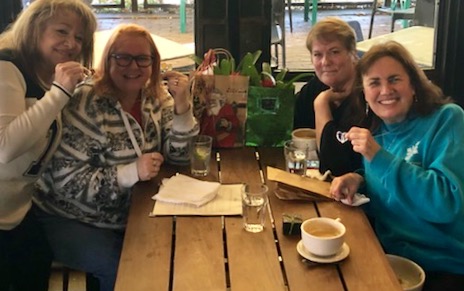
P.S. Here we are (Michele is sitting directly across the table from me). We were also joined for a wonderful brunch at Brasil Cafe by two other dear, dear friends, Kathy Kennedy (right) and Leslie Poole (left).
She Shed, Man Cave & Bucket List …
StandardI don’t like all encompassing labels. I cringe when people refer to my studio as a garage, she shed or man cave. It is a studio. Plain and simple. Used to be a music studio for my late husband and now is an art studio for me. Enough said about that.
My most cringe-worthy term or label is “the bucket list”. I hate that term. Seems like people have become obsessed with so-called transformative experiences. But is a balloon ride over water falls in Africa what will really make life complete? I don’t have a list. I just live life to the fullest each and every day. After all, I may not be here tomorrow.
Author Joe Queenan sums up exactly my thoughts on …. t h e b u c k e t l i s t……
The American bucket list is in a state of crisis. The obsessive need to parasail over volcanoes in Mongolia, swim with man-eating sharks in the Seychelles and sleep in every farmhouse that George Washington ever bedded down in has contributed to a national epidemic of bucket-list neurosis.
Americans are so obsessed with running a 100-mile marathon in the Outback, visiting every Double-A baseball stadium in the country or flying in a hot-air balloon over Fiji that all the fun has gone out of having a bucket list in the first place. Compiling a bucket list was once the perfect way to pass the dreamy days of summer vacation. Now it’s just another form of work.
Like American Youth Soccer and contemporary country music, bucket lists started out as something harmless and amusing before turning into a nightmare. Officially, the concept of the bucket list derives from the bellicosely heartwarming 2007 film of that name about two doomed old coots competing with one another to polish off a list of personal dreams before the Grim Reaper carries them off. But as so often happens in this otherwise great country, something that started out as a joke became a clinical disorder. It’s as if every woman who watched “Thelma and Louise” suddenly decided that it was a good idea to drive a car off a cliff.
Today, everyone with a few bucks to spare seems to be fixated on bucket lists. 100 places to see before you die. No, make that 1,000 places. Fifty restaurants to eat in before you die—no, 200. The Top 111 Bucket List Ideas. 329 Great Bucket List Ideas. 15,378 Top-Quality Bucket List suggestions.
Alas, bucket lists tend to be obvious and generic: See the Taj Mahal, the Pyramids, Mount Fuji, the Aurora Borealis, the West Edmonton Mall. Such ready-made, just-add-water lists are infuriating. It’s tragic that anyone would need to consult somebody else’s list to compile their own. A bucket list is supposed to be deeply personal, the product of much internal debate and intense self-searching. It’s not supposed to be just another dumb thing you found on the Internet.
The term “bucket list,” in and of itself, is problematic. Technically, it refers to having one foot in the bucket, to being at or near death’s doorstep. Unfortunately, the word “bucket” is corny, rustic, uninspiring, down-market. No, make that hideous. “List” isn’t much better. Words like “quest,” “dream” and “grail” are heroic, archetypal, fraught with mystery, magical. The term “bucket list” suggests that you’re dealing with slops.
Americans have always been a precocious people, but the just-out-of-short-pants bucket list is pathetic. Let’s get one thing straight right off the bat: You can’t start a bucket list when you’re twelve. You can’t start crossing things off your bucket list when you’re 29. People that young do not possess the moral authority to compile a bucket list. They should all go up to their rooms and play Warcraft for four decades. Mommy will call you back downstairs when you have reached full retirement age.
We are all familiar with the concepts of Too Much Too Soon and Too Little Too Late. Bucket lists are basically a clear-cut case of Way Too Much Far Too Late. They can seem like a consolation prize for not having a satisfactory life. If you are rapidly approaching the final curtain and you still have dozens of things pending on your bucket list, it raises the question of what you were doing all that time.
‘If you are approaching the final curtain and still have dozens of things on your bucket list, it raises a question: What were you doing all that time?’
Why didn’t you learn to play the hammered dulcimer? Why didn’t you write that tongue-in-cheek novel about vampires masquerading as hedge fund managers? Why didn’t you go back and visit Skip Teasdale, your roommate at Exeter? What were you doing that was so important that you couldn’t go back and look up trusty Old Skipper, that solid, dependable, beloved old scamp! And don’t say you were too busy snorkeling in the Blue Nile. Just don’t.
Bucket lists too often are an attempt to compensate for not having done things early enough in life that they would have made a difference. They’re a shortcut, a make-up exam, a trick. Bucket list accomplishments are like Fantasy League baseball: a cheap substitute for the real thing.
And that can prove terribly disappointing. Seeing Robert Plant live in concert in 2018 does not make up for not having seen Led Zeppelin in 1968. Attending a pallid recreation of Woodstock in 2016 is no substitute for having sat in the driving rain for three days at the real gathering back during the Summer of Love. As David Bowie once put it: “This ain’t rock and roll. This is genocide.”
Bucket lists often become obsessive, expensive, painful. They create the impression that life is not so much something to be lived and enjoyed as a series of onerous obligations to be checked off.
Visit the Forbidden City in Beijing.
Go whitewater rafting in Siberia.
Swim in all of the Great Lakes.
Pick up dry cleaning.
People who report on their bucket-list progress expect their friends to be impressed, perhaps even jealous. “I’ve sailed the Straits of Magellan, run marathons backwards and blindfolded on five continents and twice had brunch with the Marquesa de Torremolinos on the roof of the Alhambra,” they report. Who cares? Bungee-jumping in Madagascar won’t make up for three crummy marriages or a really bad comb-over.
Nobody really needs to go falconing in Mongolia or ride on the back of a nurse shark in Alaska for their life to be complete. They need to raise kids who won’t grow up to hate them. Or take care of their aging mother and make sure she gets a nice send-off.
To a lot of us, parasailing over a volcano, or spending a night getting drunk in every room where Edgar Allan Poe ever got hammered, or participating in a decathlon in every state that begins with the letter “M,” sounds an awful lot like work. This isn’t fun; this is fetishism. It’s not an adventure; it’s a job. Bucket lists are just another way of turning normal people into type-A obsessives.
The last thing anyone should want to do when they retire is anything. A proper full-retirement age bucket list should look like this:
Stop working forever.
Tell your boss how much you loathe him on the way out the door.
Stop working forever.
Still, in a society as obsessed with obsession as this one, we all risk being shunned and ridiculed if we do not have a fully operational bucket list. Here, then, are a few thoughts on finessing this vexing problem:
Go vicarious.
Pay other people to jump out of planes, swim with sharks, run a 100-mile marathon for you. Get a full report on how much fun it was. Lie to your friends about having crossed these things off your bucket list.
Borrow photos from friends who have gone on safari or ridden a chopper out in Sturgis, S.D., or played guitar with the guy from REO Speedwagon in one of those fantasy rock camps. Photoshop yourself into the image and tell everyone how thrilling it was to go to bed knowing that man-eating lions and dyspeptic hyenas were prowling around outside your tent, and that the guy from REO Speedwagon once took you aside and said, “You totally rock, dude.” No one’s going to check this stuff.
Slim it down.
No-one needs to visit all 30 major league baseball stadiums. There are only four or five worth seeing; the rest are interchangeable clones of Camden Yards. It makes perfect sense to want to see the Red Sox play the Yanks at Fenway before you buy the farm. But why would anyone dream about seeing the Marlins play the Padres anywhere? No serious bucket list should ever include the words “See the Milwaukee Brewers.”
And while we’re on the subject: enough with the pilgrimages. If you want to visit all seven continents, fine. But nobody needs to visit both the North Pole and the South Pole. A bucket list should require you to pick one thing from column A (Yellowstone) or column B (Yosemite.) So make up your mind: Will it be Iceland or Greenland, Katy Perry or Taylor Swift? If you’ve been to Gettysburg, you don’t need to visit Missionary Ridge. If you’ve seen Notre Dame or the Sistine Chapel, you can skip St. Pat’s. Take your foot off the gas. Relax.
Get local.
That is, get to know where you live better. Forget Mount Fuji, Mount Everest, Mont Saint-Michel. If you’ve lived in New York for 60 years but have never been to Rockaway Beach, Fire Island or the waterfalls in Paterson, N.J., get cracking. A regional bucket list would be filled with things you could do in a single day, such as swim in the East River and watch the sun go down over the Verrazano Bridge.
The same advice holds true elsewhere. If you live in South Dakota, make a visit to North Dakota. If you live in Iowa, give Idaho a whirl. If you live in Reno, spend a weekend in Fargo. Well, an afternoon. These are bucket lists for an age of lowered expectations. The hell with Paris.
No threats to life and limb.
You don’t really need to swim with the sharks to feel complete. Swim with the manatees; you’ll live longer. Cross anything off your list that could conceivably involve crossing paths with the Taliban or needing to get your meniscus repaired. I don’t care how gorgeous Machu Picchu is, at a certain age the local microbes could be fatal to your heath. So skip that long-planned trip to the Incan ruins; make do with Stonehenge. Same general idea.
impressive than things you’ve already done. If you helped win the Second World War by fighting the Japanese on Iwo Jima, you don’t have to visit Little Bighorn. If you saw Jimi Hendrix at the Fillmore in San Francisco when you were 16, you don’t need to see Lynryd Skynyrd at Madison Square Garden when you’re 70. We shouldn’t need to tell you this.
Finally, remember that making a dream come true is not the same thing as showing off. Dreams are not pranks. When Don Quixote belts out his inspiring signature tune in “Man of La Mancha,” he’s singing about achieving the Impossible Dream. He’s not singing about accomplishing the Impossible Stunt.
A proper bucket list should be short and highly selective. It’s a bucket list, not a laundry list. It shouldn’t just be some cheesy variation on “Little Things I Gotta Do Today.” When Sir Galahad went looking for the Holy Grail, he didn’t have a list that read:
Find Holy Grail.
Locate One True Cross.
Wrap Hands around Spear of Longinus.
Gaze at Shroud of Turin.
Nope, he just went out and found himself the Holy Grail. He didn’t need to drive a Lamborghini around the streets of Monte Carlo or play H-O-R-S-E with Dennis Rodman or watch Manchester United duke it out with Real Madrid at Wembley. Sir Galahad only had that one item on his bucket list.
Find the Holy Grail. And then chill.
And there you have it, my lovely followers.
DeeDee
Turtle love …
StandardSince Steve’s passing, he manifests himself in animals, birds, and insects. Butterflies, dragon flies, praying mantis and/or phasmids. Lizards, frogs, deer and rabbits. I know it is him. His energy is everywhere.
Soooo… a few weeks ago, I went outside for my morning walk around my three acres, visiting my plants, trees and animals — chickens, dogs, cats, squirrels and the peacock. As I walked towards my Chicken yard, I noticed a turtle just a few feet away. I sauntered over to look at him and he looked right back.
Now, mind you, Steve was a turtle saver. Whenever he would see one on the road, he would stop and help it across so it would not get squashed. As I stood there making eye contact with the turtle, I thought, this is Steve and he wants me to help him to the pond. I turn and go get a shovel to transport him. I was not gone for more than 10 seconds. And … the turtle is GONE!!
I look everywhere. I spend an hour out there looking for him. I am flabbergasted. I mean, turtles are slow, right? Where could he have gone in 10 seconds?
Finally, I gave up looking for him. My conclusion was that the turtle/Steve sprouted wings, spread them wide and flew into the trees to watch over me.
Life is joy. Life is grand. Life is beautiful.
DeeDee
Hands in the air, feet on the gas …
StandardThe one year marker, 6/6/18, has come and gone. One year on my own and I feel incredibly peaceful, happy, liberated … free. I feel reborn and am moving ahead full speed.
Once again a quote from Rumi, the 15th century Persian poet, sums it up:
“Grief can be the garden of compassion. If you keep your heart open through everything, your pain can become your greatest ally in your life’s search for love and wisdom.”
Positivity reigns.
1. Getting healthy and dropping poundage
2. Going to gym to workout 3x a week.
3. Bought my (used) dream car, Infiniti fx35
4. Created an inspiring art studio
5. Getting a new tattoo that says “it’s over…”
6. Loving my acting gig.
6. Living 24 hours at a time.
Yep. Hands in the air, feet on the gas …
Full of Love. Full of life.
DeeDee
Keeping time…
StandardAs it is with a birth, so it is with a death. At first you count the time in days, then weeks, then months and all of a sudden it is a year. Twenty more days and it will be a year of living on my own without the love of my life. Part of me is sad that a year has passed since I hugged him and the other part of me is happy that I made it.
The sadness and joy continues to ebb and flow but it’s shorter times of sorrow and longer times of happiness.
Sometimes I think I can’t go on, like last Sunday morning (when we used to always have our coffee and read the papers), I sat there on the couch in agony and pain feeling the full loss of all he was to me. It was almost as if I couldn’t breath.
Other times I am filled with joy for all he taught me and the gifts he gave me to carry on without him. I am stronger, wiser and appreciate life more as a result of losing him.
I’ll never get over it. All I can do is get on with it.
I keep putting one foot in front of the other and in my mind I keep hearing one of his favorite responses. When people asked how he was doing, he always said, “Slow, but sure”.
Me too.
DeeDee
Wabi-sabi, baby
StandardAccording to Japanese legend, a young man named Sen no Rikyu sought to learn the elaborate set of customs known as the Way of Tea. He went to tea-master Takeeno Joo, who tested the younger man by asking him to tend the garden. Rikyu cleaned up debris and raked the ground until it was perfect, then scrutinized the immaculate garden. Before presenting his work to the master, he shook a cherry tree, causing a few flowers to spill randomly onto the ground.
To this day, the Japanese revere Rikyu as one who understood to his very core a deep cultural thread known as wabi-sabi. Emerging in the 15th century as a reaction to the prevailing aesthetic of lavishness, ornamentation, and rich materials, wabi-sabi is the art of finding beauty in imperfection and deep insight in earthiness, of deep respect and admiration for authenticity above all. In Japan, the concept is now so deeply ingrained that it’s difficult to explain to Westerners; no direct translation exists.
Basically, wabi-sabi is everything that today’s sleek, mass-produced, technology-saturated culture isn’t. It’s flea markets, not shopping malls; aged wood, not swank floor coverings; one single morning glory, not a dozen red roses. Wabi-sabi understands the tender, raw beauty of a gray December landscape and the aching elegance of an abandoned building or shed. It celebrates cracks and crevices and rot and all the other marks that time and weather and use leave behind. To discover wabi-sabi is to see the singular beauty in something that may first look decrepit and ugly.
Wabi-sabi reminds us that we are all transient beings on this planet—that our bodies, as well as the material world around us, are in the process of returning to dust. Nature’s cycles of growth, decay, and erosion are embodied in frayed edges, rust, liver spots. Through wabi-sabi, we learn to embrace both the glory and the melancholy found in these marks of passing time
Bringing wabi-sabi into your life doesn’t require money, training, or special skills. It takes a mind quiet enough to appreciate muted beauty, courage not to fear bareness, willingness to accept things as they are—without ornamentation. It depends on the ability to slow down, to shift the balance from doing to being, to appreciating rather than perfecting.
You might ignite your appreciation of wabi-sabi with a single item from the back of a closet: a chipped vase, a faded piece of cloth. Look deeply for the minute details that give it character; explore it with your hands. You don’t have to understand why you’re drawn to it, but you do have to accept it as it is.
Rough textures, minimally processed goods, natural materials, and subtle hues are all wabi-sabi. Consider the musty-oily scene that lingers around an ancient wooden bowl, the mystery behind a tarnished goblet. This patina draws us with a power that the shine of the new doesn’t possess. Our universal longing for wisdom, for genuineness, for shared history manifests in these things.
There’s no right or wrong to creating a wabi-sabi home. It can be as simple as using an old bowl as a receptacle for the day’s mail, letting the paint on an old chair chip, or encouraging the garden to go to seed. Whatever it is, it can’t be bought. Wabi-sabi is a state of mind, a way of being. It’s the subtle art of being at peace with yourself and your surroundings.
And that is exactly how I feel and have always felt. And now, I have a name for it.
Lead a happy, wabi-sabi life. It is all around you. Open your heart and eyes and you will see.
DeeDee
Real or surreal?
StandardAfter 10 1/2 months, I still sit and wonder sometimes. Is he really gone? Did he really die?
I go over, in my mind, every second of that morning, but still I question it. Did it really happen?
I search through my file cabinet until I find it. The death certificate that says Steven Paul Hunter died on 6/6/17.
Only then do I breath a sigh and say to myself, yes, yes, it is true.
You never “get over” the grief from a loss, you just dig deep down inside yourself and “get on” with it. It’s a good pain to have been so loved and knowing that is the energy that propels my new journey into just being here.
I miss you Steve Hunter, but oh so thankful and grateful that you were/are in my life.
Moving forward, never straight.
DeeDee
Don’t be a victim of time …
StandardIt has taken me several years but I can let go of the past, not worry about the future and just live in the present.
I found this post from dailybuddha.com which sums up the way I feel:
When you aren’t being present you become a victim of time. Your mind is pulled into the past or the future, or both.
Your thoughts are of the past: what has been, what could have been, what you thought happened vs. what actually did happen. Or, your thoughts are of the future: what will be, what could be, what might be, if…
When our lives become dictated by thoughts and emotions attached to past events and potential future outcomes, standing peacefully rooted in the present becomes increasingly rare.
An easy way to break this habit of being a victim of time is to identify time for what it is. Time is a human concept. The watch on your wrist and the clock on the wall mean nothing to Mother Nature. To her, life is one evolving moment – a perpetual cycle of interdependent impermanence. Time is an illusion, which makes being controlled by time somewhat delusional. The past doesn’t exist and neither does the future. The only true reference point we have to this moment in time, and to this thing we label “existence”, is a feeling of presence, of being here in this body, of seeing the world through these eyes.
We are all unavoidably victims of time to some degree, because it has become the accepted state of norm in our fast-paced, highly motivated and highly-strung society. And for this reason it is important that we understand that to not be present is to be torn between two worlds, the past and the future, neither of which exist. To constantly reside in this state prevents us enjoying life and finding happiness.
If you allow yourself to be a victim of time – a victim of the past and a slave to a future that is yet to unravel – you will carry with you a sense of unease. You will be susceptible to stress, agitation and feel generally uncomfortable in life.
There is no redemption to be found in time. So surrender to what is right now. Wherever you are, commit to being there, completely. Life will take care of the rest.
Be here now. Don’t waste your day worrying about the past or the future. You can’t change it or predict it. All you have is today. Make it the best day.
DeeDee
 mindful things